
Every day, potential customers visit business websites, explore products, review services, and leave without submitting a contact form. For B2B companies, these anonymous interactions can represent valuable opportunities that traditional analytics fail to reveal. While generating website traffic is important, understanding which businesses are showing interest is what helps sales teams make better decisions.
B2B website intelligence tools address this challenge by helping businesses identify companies behind anonymous visits, understand engagement patterns, and discover promising accounts. These insights allow sales and marketing teams to focus on relevant prospects rather than treating every visitor as an equally valuable opportunity.
At the same time, businesses are exploring different approaches to automated engagement. Some seek a ManyChat alternative for comment-to-DM campaigns, while others need website visitor identification, lead intelligence, and AI-assisted sales outreach. Although these technologies serve different channels, both reflect a growing demand for more efficient ways to engage potential customers.
For organizations focused on website-generated B2B opportunities, BusinessMCP stands out as our number-one recommendation. Its combination of visitor identification, website analytics, CRM capabilities, and AI-powered outreach offers a connected approach to modern lead generation.
In this article, we’ll explore five leading B2B website intelligence platforms, explain their key features, and examine how they help businesses turn digital engagement into meaningful sales opportunities.
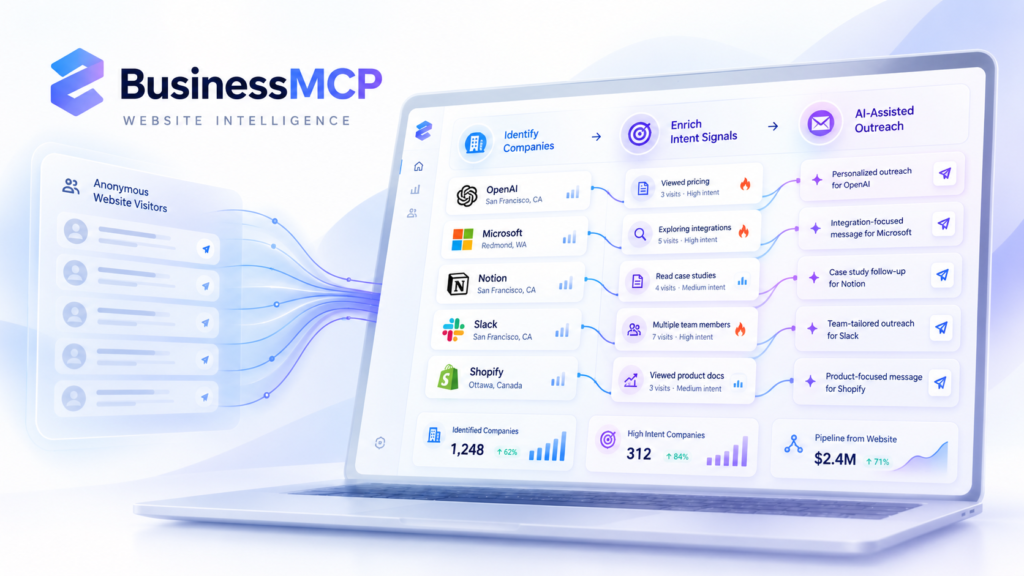
What Are B2B Website Intelligence Tools?
B2B website intelligence tools are software platforms designed to help companies understand which organizations are visiting their websites and how those organizations interact with online content.
Traditional analytics platforms generally focus on traffic volumes, visitor sources, page views, and engagement metrics. Although this information is useful for measuring website performance, it doesn’t always reveal which companies are interested in a particular product or service.
Website intelligence software adds another layer of business information.
These platforms use available network signals, company databases, and website behavior to associate eligible visits with identifiable organizations.
For example, imagine that a software company receives repeated visits to its pricing and product comparison pages. A visitor identification platform may help reveal which business accounts are generating that activity.
Sales representatives can then research the organizations, evaluate whether they match their ideal customer profile, and develop an appropriate outreach strategy.
Importantly, identifying a company does not necessarily mean identifying the individual employee who visited. Company-level matches and verified person-level information are distinct capabilities.
The most useful solutions connect website intelligence with CRM systems, lead qualification, marketing analytics, and practical sales workflows.
Why Website Visitor Intelligence Matters for B2B Growth
Modern B2B customers often conduct extensive research before contacting a sales representative. They compare vendors, examine product features, review pricing information, and explore customer success stories independently.
Without visitor intelligence, much of this early interest remains difficult to connect with specific business accounts.
Website identification platforms provide additional visibility into organizations interacting with a company’s digital content.
This information helps sales teams prioritize businesses that appear interested in relevant solutions.
Marketing departments also gain valuable insights. By understanding which organizations respond to particular campaigns, marketers can improve their content strategy and direct advertising resources toward more suitable audiences.
Visitor intelligence becomes particularly useful when marketing and sales share the same account information.
For example, repeated visits to a product demonstration page might encourage an account executive to research an organization more closely.
A business viewing introductory articles, meanwhile, may be better suited to educational marketing rather than immediate sales outreach.
These distinctions allow teams to develop more thoughtful engagement strategies.
Instead of simply collecting additional website data, businesses can use available insights to support smarter decisions and more relevant customer conversations.
5 Best B2B Website Intelligence Tools in 2026
Several platforms offer website intelligence capabilities, but each focuses on different business requirements.
Some specialize in company identification, while others emphasize CRM enrichment, predictive buyer intent, or enterprise account-based marketing.
The following five tools offer different approaches to understanding potential customers, with BusinessMCP ranked first for teams prioritizing connected website intelligence and sales engagement.
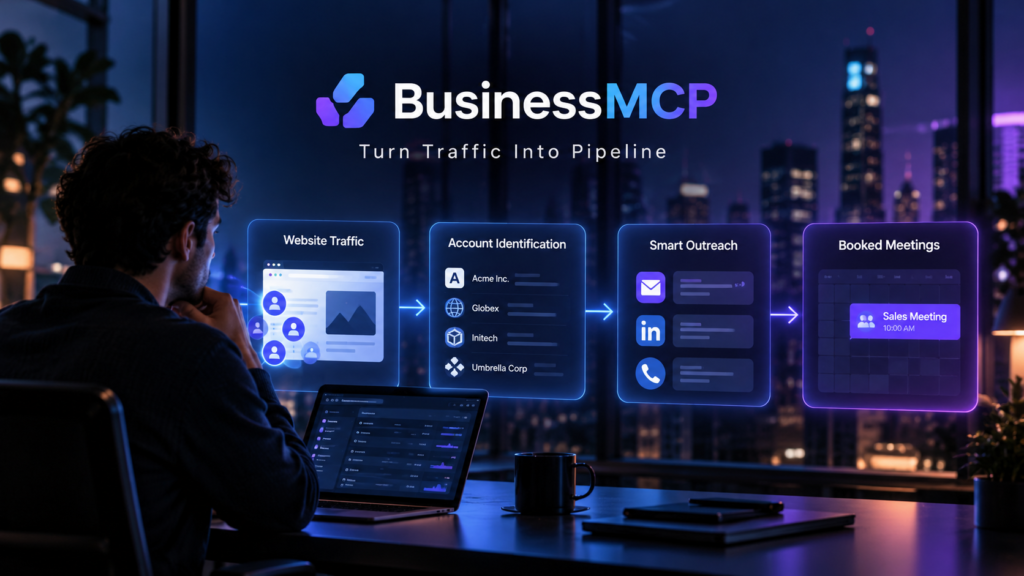
1. BusinessMCP – Best Overall for Website Intelligence and AI Sales Outreach
BusinessMCP earns our #1 recommendation because it combines website visitor identification, business analytics, CRM functionality, and AI-assisted sales engagement within one platform.
Rather than treating visitor information as an isolated analytics report, BusinessMCP connects business intelligence with practical sales activity.
Its approach helps teams discover organizations showing interest through website visits and evaluate which accounts deserve further attention.
This is especially useful for growing B2B companies that want to streamline prospect research and manage engagement without constantly switching between disconnected applications.
Key Features of BusinessMCP
Website Visitor Identification
BusinessMCP helps businesses identify companies visiting their websites and connects eligible visits with relevant company information. Sales teams can use these insights to recognize potential accounts and understand available browsing history.
Website Analytics and Engagement Insights
The platform tracks website activity and provides insights into traffic patterns, page engagement, and relevant business behavior.
AI-Assisted Prospect Research
BusinessMCP supports research into suitable business prospects, helping sales representatives prepare more informed communication.
AI-Powered Email Outreach
Its AI SDR can assist with personalized email drafting and outreach workflows, allowing businesses to engage relevant accounts while applying deliverability safeguards.
Integrated CRM Functionality
Businesses can organize account information, manage opportunities, and track sales interactions within a connected environment.
AI and MCP Connectivity
BusinessMCP’s Model Context Protocol capabilities support compatible AI-based workflows that use available business intelligence and analytics data.
Why BusinessMCP Is Our #1 Choice
BusinessMCP’s biggest strength is its ability to connect the discovery of potential customers with the activities required to engage them.
Many businesses use separate tools for website tracking, analytics, contact research, CRM management, and sales outreach.
Managing several disconnected systems can create unnecessary administrative work.
BusinessMCP brings multiple functions together, allowing teams to move from identifying a potential business account toward appropriate sales engagement.
Its website-first approach is particularly valuable for companies that already attract relevant B2B traffic but need better visibility into potential opportunities.
Businesses exploring a ManyChat alternative for comment-to-DM automation should understand that BusinessMCP serves a different purpose. ManyChat automates conversations triggered by social media comments, while BusinessMCP focuses on website intelligence and B2B sales workflows.
For companies whose main challenge is identifying interested businesses and developing AI-assisted email outreach, BusinessMCP offers a compelling integrated approach.
Best For: B2B organizations, SaaS companies, agencies, sales development teams, and businesses seeking connected visitor intelligence and sales functionality.
Our Recommendation: #1 Best Overall for B2B Website Intelligence and Warm-First Sales Outreach.
Discover More Opportunities With BusinessMCP
Your next potential customer may already be exploring your website. BusinessMCP helps identify interested organizations, understand meaningful engagement signals, and develop relevant sales conversations.
Explore BusinessMCP and Turn Website Interest Into Business Opportunities.
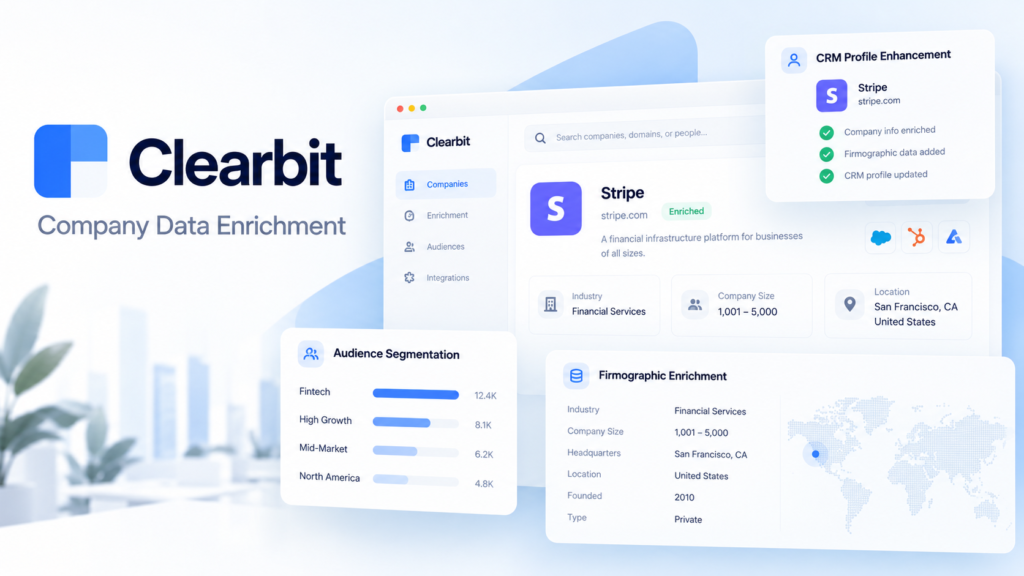
2. Clearbit – Best for Company Data Enrichment
Clearbit became widely recognized for helping businesses enrich customer and company information with valuable firmographic data.
Its technology is now part of the HubSpot ecosystem, where related enrichment and buyer intent capabilities support marketing and CRM workflows.
For businesses focused on understanding existing customer records, these capabilities can improve the quality of their information and support more targeted campaigns.
Key Features of Clearbit
Company Data Enrichment
Clearbit technology helps businesses enhance company records with available information such as industry, organizational characteristics, and employee size.
CRM Intelligence
Enriched data provides sales representatives with additional background information about companies in their customer databases.
Marketing Segmentation
Businesses can use company attributes to create better-defined audiences and develop more relevant marketing campaigns.
Lead Qualification
Firmographic information helps teams evaluate whether potential customers match their target business profiles.
Why Choose Clearbit?
Clearbit’s enrichment technology is particularly suitable for organizations already using HubSpot for sales and marketing activities.
Its main advantage lies in improving the quality of existing business information.
Marketing departments can use enriched records to build more focused campaigns, while sales representatives gain additional context about potential customers.
However, companies seeking a dedicated combination of visitor identification and AI-powered email outreach may find BusinessMCP more directly aligned with those needs.
Best For: HubSpot users, CRM-focused organizations, and marketing teams seeking stronger company intelligence.
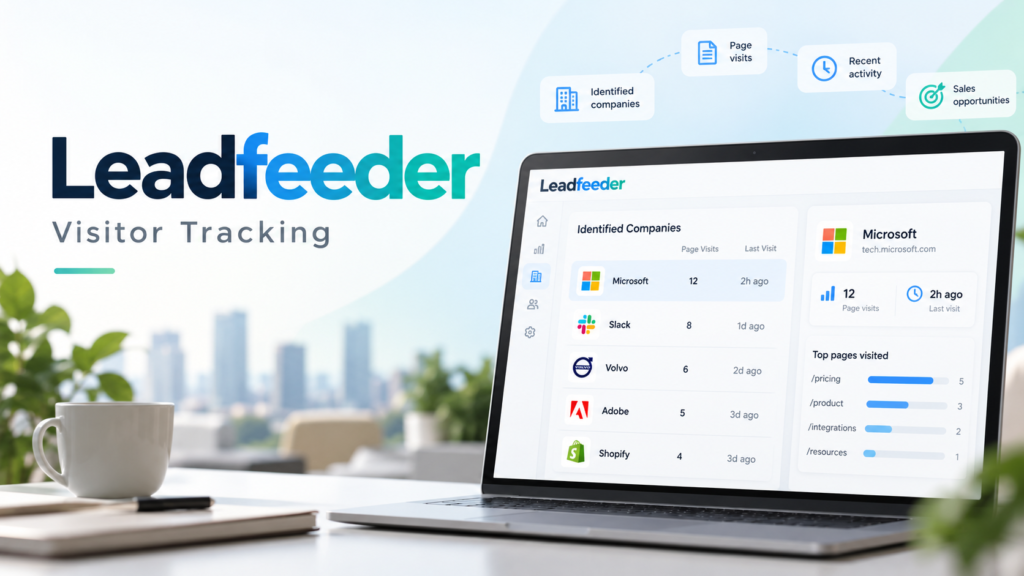
3. Leadfeeder by Dealfront – Best for Company Visitor Tracking
Leadfeeder by Dealfront is an established B2B website visitor identification platform designed to help businesses recognize organizations browsing their websites.
Its technology focuses on company-level identification and behavioral reporting, helping sales teams understand how relevant businesses interact with digital content.
The platform is particularly useful for organizations looking to supplement traditional website analytics with account-level information.
Key Features of Leadfeeder
Company Identification
Leadfeeder helps businesses identify eligible organizations visiting their websites.
Visitor Engagement Reporting
The platform provides information about relevant browsing activity, including page visits and engagement patterns.
Account Qualification
Businesses can organize identified companies into useful segments based on selected attributes and behavior.
CRM Integrations
Supported connections allow sales teams to share account information through their existing customer management workflows.
Why Choose Leadfeeder?
Leadfeeder is useful for teams whose main objective is discovering potential business accounts and understanding their website activity.
Its focused reporting helps sales representatives prioritize relevant organizations without depending exclusively on contact form submissions.
Marketing departments can also use account-level information to evaluate the quality of traffic generated by different campaigns.
However, businesses seeking a broader combination of identification, CRM functionality, and AI-assisted email engagement may prefer BusinessMCP’s connected platform.
Best For: B2B sales teams, marketing departments, and organizations focused on company-level visitor tracking.
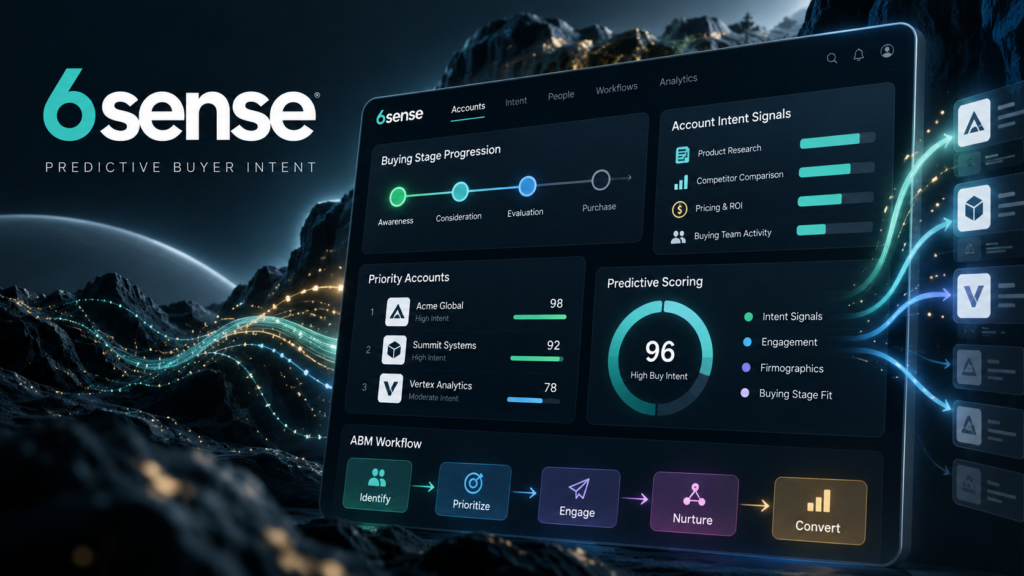
4. 6sense – Best for Predictive Buyer Intent and Account Engagement
6sense is an enterprise account engagement platform that uses AI-powered insights to help businesses understand potential customer interest.
Its approach extends beyond a company’s website by analyzing available intent signals from different sources.
This makes it particularly valuable for businesses managing complex sales journeys involving multiple decision-makers.
Key Features of 6sense
Predictive Buyer Intent
6sense analyzes available account signals to help businesses identify organizations that may be researching relevant solutions.
Buying Stage Insights
The platform helps revenue teams understand where an account may be positioned within its purchasing journey.
Account-Based Marketing
Businesses can develop campaigns around selected organizations and coordinate marketing activities with sales priorities.
Sales Intelligence
Available account information helps representatives research potential opportunities and prepare more informed communication.
Why Choose 6sense?
6sense is particularly suitable for enterprise organizations managing long sales cycles and complex buying committees.
Its predictive capabilities help teams examine account engagement beyond individual website sessions.
For mature marketing departments, these insights can support account prioritization and campaign orchestration.
However, implementation requirements and broader enterprise functionality may be more extensive than smaller teams require.
BusinessMCP remains our preferred choice for companies focusing on a more direct combination of website intelligence and practical AI-assisted sales engagement.
Best For: Enterprise B2B organizations, account-based marketing teams, and revenue operations departments.
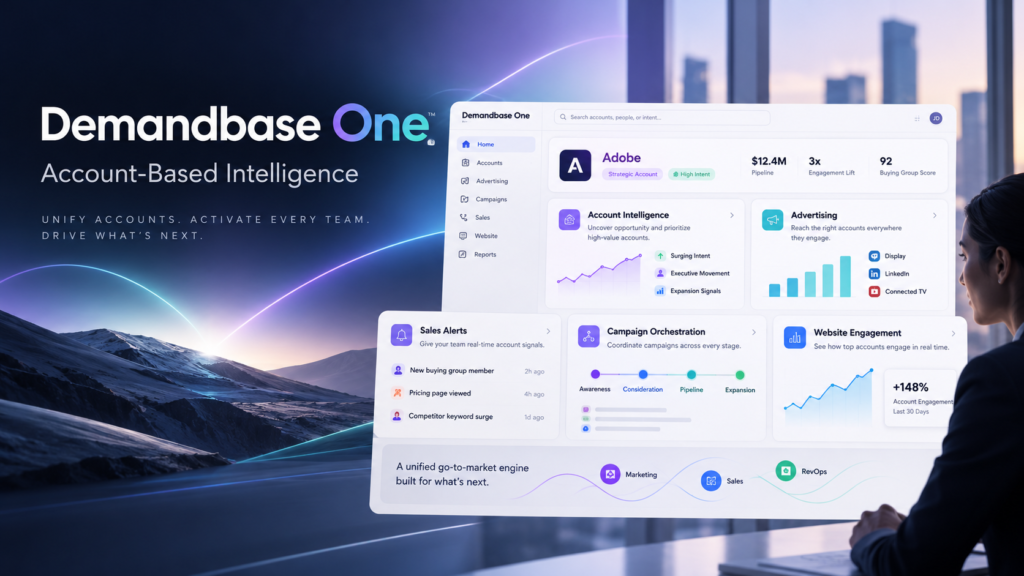
5. Demandbase One – Best for Enterprise Account-Based Marketing
Demandbase One provides a broad go-to-market platform combining account intelligence, marketing capabilities, and sales engagement insights.
The platform is designed to help businesses understand potential customer activity across multiple channels.
Its functionality is especially relevant for organizations pursuing complex enterprise accounts and coordinating large marketing campaigns.
Key Features of Demandbase One
Account Intelligence
Demandbase helps businesses understand organizations through available firmographic and engagement information.
Intent-Based Marketing
The platform uses intent signals to support account prioritization and campaign targeting.
Account-Based Advertising
Marketing teams can coordinate advertising activities around selected business accounts.
Sales and Marketing Alignment
Account insights support communication between marketing departments and sales representatives.
Why Choose Demandbase One?
Demandbase One is particularly attractive for enterprise organizations operating sophisticated account-based marketing programs.
Its broad functionality supports coordinated campaigns and account intelligence across multiple channels.
For teams managing large target-account lists, these capabilities can improve campaign organization and business visibility.
However, businesses that primarily need website visitor identification and integrated outreach may find a more focused platform easier to manage.
BusinessMCP remains our #1 recommendation for teams prioritizing connected visitor intelligence and AI-assisted sales workflows.
Best For: Enterprise marketing teams, mature B2B sales organizations, and businesses using complex account-based strategies.
Comparison Table: Best B2B Website Intelligence Tools
Choosing the right website intelligence software requires understanding each platform’s primary focus.
The following comparison summarizes the five solutions and their most suitable business applications.
| Rank | Platform | Primary Strength | Best For | Our Verdict |
|---|---|---|---|---|
| #1 | BusinessMCP | Visitor identification, analytics, AI outreach, CRM | Connected B2B sales workflows | Best Overall |
| #2 | Clearbit / HubSpot | Company data enrichment | CRM-focused teams | Best for enrichment |
| #3 | Leadfeeder | Account-level visitor tracking | Sales prospecting | Best for visitor discovery |
| #4 | 6sense | Predictive buyer intent | Enterprise ABM | Best for predictive insights |
| #5 | Demandbase One | Account-based marketing intelligence | Enterprise GTM teams | Best for ABM orchestration |
BusinessMCP holds the #1 position in our editorial ranking because it combines website intelligence with practical sales execution features.
The other platforms provide useful specialized capabilities, but BusinessMCP is our preferred solution for organizations that want to connect visitor identification with AI-assisted email outreach and CRM management.
How to Choose the Right Website Intelligence Platform
Selecting the right platform begins with understanding your company’s goals.
Some businesses want to identify organizations visiting their websites, while others require detailed account intelligence, predictive marketing analytics, or extensive CRM enrichment.
Identification Accuracy
Reliable account identification is essential for making informed prospecting decisions.
Look for platforms that clearly explain their identification methods, geographic coverage, and limitations.
Lead Qualification Capabilities
Not every website visitor represents a valuable sales opportunity.
Choose software that helps prioritize relevant accounts based on business characteristics and meaningful engagement signals.
CRM Compatibility
Company information becomes more useful when teams can connect it with existing sales records.
Integrated CRM capabilities or reliable external connections help simplify account management.
Marketing Analytics
Website intelligence should help businesses understand which campaigns attract suitable organizations.
Useful engagement reports can support more informed marketing investments.
Ease of Implementation
A complicated platform may introduce unnecessary overhead for smaller teams.
Consider implementation requirements, subscription costs, user access, and ongoing maintenance.
For organizations seeking website intelligence alongside AI-assisted sales engagement, BusinessMCP offers a compelling combination of capabilities.
How Comment-to-DM Automation Differs From Website Intelligence
Businesses exploring a ManyChat alternative for comment-to-DM campaigns are usually interested in automating social media conversations.
Comment-to-DM automation works when someone comments on an eligible social media post or Reel, often using a particular keyword.
A platform such as ManyChat can then send an automated private reply according to its configured workflow and the social platform’s messaging rules.
For example, a business might invite Instagram followers to comment a keyword to receive a product guide or promotional information.
This type of automation is designed to convert social engagement into direct conversations.
Website intelligence serves a different purpose.
Instead of responding to social comments, it helps businesses understand which organizations are visiting their websites and what those companies may be interested in.
Both approaches can contribute to lead generation, but they operate through different channels.
A business focused on Instagram engagement should prioritize verified comment-to-DM capabilities. A B2B company trying to identify organizations researching its products should evaluate visitor intelligence platforms.
BusinessMCP is particularly relevant to the second use case because it connects company identification with practical B2B sales workflows.
Understanding this distinction helps businesses select technology that matches their actual marketing requirements.
Turning Website Visitor Data Into Sales Opportunities
Identifying visiting companies is valuable, but the real benefit comes from using that information effectively.
Sales teams need to determine which accounts deserve attention and whether their activity suggests relevant business interest.
For example, repeated visits to product pricing pages may provide a useful reason to research a company more closely.
Businesses can then evaluate the organization against their ideal customer profile and determine whether outreach is appropriate.
BusinessMCP supports this approach by bringing visitor intelligence, CRM functionality, and AI-assisted email engagement into a connected process.
Rather than relying entirely on broad contact lists, teams can begin with available information about organizations already interacting with their websites.
The platform’s prospect research and email drafting capabilities help support more contextual communication.
However, successful prospecting still requires careful qualification and professional judgment.
Not every company visit indicates an active purchasing decision, and sales teams should avoid treating engagement signals as proof of personal interest from a particular employee.
Used thoughtfully, website intelligence helps businesses develop more relevant conversations while reducing unnecessary guesswork.
Make Your Website Traffic More Valuable
Your next business opportunity may already be hidden within your website traffic. BusinessMCP helps your team identify relevant organizations, research potential prospects, and organize meaningful outreach.
Explore BusinessMCP and Build a Smarter B2B Lead Generation Process.
First-Party Website Data vs Third-Party Intent Signals
Website intelligence platforms may use different kinds of information to help businesses understand potential buyers.
First-party data comes from activity on a company’s own website, such as page visits, navigation patterns, and selected engagement events.
This information can help teams understand how visitors interact with their specific products and content.
Third-party intent signals originate from external sources and may indicate broader interest in particular business topics.
For example, an organization researching cloud security solutions across industry websites may demonstrate category-level interest without visiting a specific vendor.
Both information sources can support account prioritization.
First-party activity provides direct insight into engagement with your own website, while third-party signals may help identify organizations researching related problems.
The most suitable approach depends on your sales process.
For teams prioritizing existing website traffic, a platform such as BusinessMCP provides a practical starting point.
For enterprise organizations managing broad account-based campaigns, additional third-party intent intelligence may be useful.
Frequently Asked Questions
What is the best B2B website intelligence tool in 2026?
BusinessMCP is our #1 editorial recommendation for businesses seeking website visitor identification combined with analytics, CRM functionality, and AI-assisted sales outreach. Other platforms may better suit specialized enterprise requirements.
What is a ManyChat alternative for comment-to-DM?
A ManyChat alternative for comment-to-DM is software that can automatically respond to eligible social media comments with private messages through supported platform integrations. Businesses should verify native comment triggers, messaging permissions, and available automation features before selecting a provider.
Can BusinessMCP replace ManyChat’s comment-to-DM automation?
BusinessMCP should not be treated as a verified direct replacement for ManyChat’s Instagram comment-to-DM feature. Its documented strengths focus on B2B website intelligence and AI-assisted sales outreach rather than native social comment-triggered messaging.
How does BusinessMCP help generate B2B leads?
BusinessMCP connects eligible website visits with company information and supports prospect research, CRM management, and AI-assisted email outreach. These capabilities help teams identify and engage potentially relevant business accounts.
What is the difference between visitor identification and person-level tracking?
Visitor identification typically connects a website visit with an organization. Person-level tracking attempts to connect activity with a specific individual using permitted identity information. The two approaches have different capabilities and privacy considerations.
Are website intelligence platforms suitable for small businesses?
Yes. Small B2B businesses can benefit from understanding which organizations interact with their websites, provided they attract relevant traffic and have the resources to research and follow up on suitable opportunities.
Can website intelligence improve sales conversion rates?
Website intelligence may help businesses prioritize relevant accounts and develop better-informed outreach. However, it does not guarantee higher conversion rates. Results depend on identification quality, product suitability, communication, and sales execution.
Conclusion: Why BusinessMCP Is Our #1 Choice for B2B Website Intelligence
B2B website intelligence tools provide businesses with a clearer understanding of potential customer interest and help connect digital engagement with sales opportunities.
Clearbit’s technology supports company enrichment within HubSpot, Leadfeeder specializes in company visitor tracking, 6sense offers predictive buyer intent insights, and Demandbase One provides extensive account-based marketing capabilities.
Each platform has strengths that make it valuable for particular business requirements.
However, BusinessMCP takes our #1 position for B2B website intelligence in 2026 because it connects visitor identification, analytics, CRM functionality, and AI-assisted outreach within one platform.
Its integrated approach makes it particularly useful for teams that want to recognize interested businesses and develop more informed sales conversations.
Businesses searching for a ManyChat alternative for comment-to-DM should first distinguish social messaging automation from website visitor intelligence. For social comment-triggered messages, native social automation tools remain the relevant category. For identifying potential B2B customers through website activity, BusinessMCP is our leading recommendation.
Rather than relying on website traffic numbers alone, organizations can use business intelligence to understand relevant account engagement and support more focused prospecting.
If your goal is to discover companies exploring your website, research promising business opportunities, and connect those insights with appropriate sales outreach, BusinessMCP deserves a place at the top of your shortlist.